
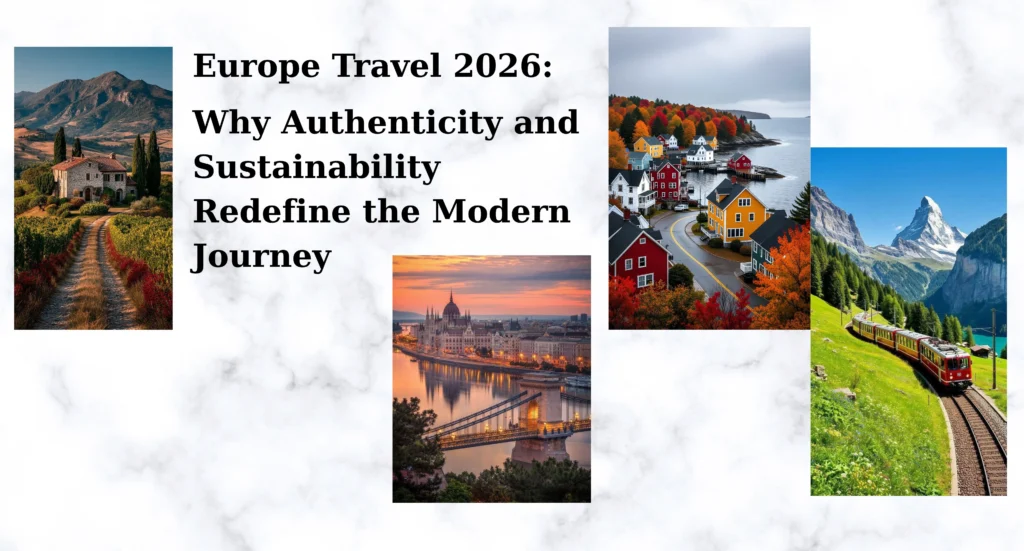
Europe travel 2026 marks a turning point in the evolution of global tourism. After years dominated by mass travel, overcrowded capitals, and superficial “checklist vacations,” travelers entering 2026 demand something fundamentally different: authenticity, cultural depth, sustainable movement, and emotional connection. The phrase Europe travel 2026 captures not just a shift in destinations, but a profound shift in the traveler’s mindset. Comfort remains important, but meaning becomes essential.
1. Slow Travel Becomes the New Foundation
One of the strongest pillars of Europe travel 2026 is the widespread adoption of slow travel. Travelers increasingly reject rushed itineraries, short city breaks, and the habit of visiting too many countries in a single week. Instead, they choose an unhurried pace, often staying in one region for ten, fifteen, or even twenty days.
Slow travel encourages travelers to connect deeply with the environment around them. They walk more, talk more, and observe more. A visitor to Portugal’s Alentejo region might spend days exploring vineyards, tasting olive oil, listening to local stories, or simply watching the sunset over rolling hills. In Slovenia, travelers choose to hike through pristine forests accompanied by local naturalists who explain biodiversity in detail. In Romania, tourists spend extended stays in traditional guesthouses in Maramureș or Transylvania, learning how bread, cheese, or ceramics are made.
The purpose is not to collect photos, but to collect experiences that change one’s perspective.
2. Smaller Towns Become the Stars of 2026
Crowded destinations such as Paris, Barcelona, and Amsterdam are no longer the primary choices. With new Overcrowded capitals begin to impose restrictions — visitor taxes, entrance quotas, digital reservations for museums, and limits on cruise ships. As a result, travelers look elsewhere, and Europe’s small towns shine more brightly than ever.
Trieste in Italy, often overlooked, becomes a symbol of multicultural elegance, where Italian architecture merges with Austrian history and Slavic influences. Plovdiv in Bulgaria rises as a cultural hotspot thanks to its layers of ancient and modern identity. Setúbal in Portugal mixes marine beauty with vineyards, without the overwhelming crowds of the Algarve.
These destinations preserve authenticity, local rhythm, and human warmth. They become central examples of the Europe travel 2026 trend: meaningful exploration supported by responsible tourism policies.
3. Sustainability Becomes a Mandatory Standard
Europe travel 2026 strengthens sustainable tourism beyond anything seen before. Travelers no longer see sustainability as a bonus but as an expectation. Hotels that fail to adopt eco-friendly practices lose attractiveness, while green-certified accommodations gain significant visibility.
Some of the most impactful changes include:
- widespread use of solar-powered hotels;
- zero-waste restaurant models;
- low-emission transportation routes;
- preservation fees dedicated to local biodiversity;
- AI-assisted monitoring of visitor traffic in natural parks.
Norway, Switzerland, and Slovenia lead the continent in implementing innovative green infrastructure. Silent electric trains connect remote valleys, while smart systems measure environmental pressure and automatically limit tourist access when necessary.
For travelers, sustainability becomes a part of the story: choosing accommodation, food, and transport is an ethical gesture that reinforces the meaning of the experience.
4. AI Transforms Trip Planning and On-Site Experiences
Artificial intelligence fundamentally reshapes Europe travel 2026. AI travel assistants do more than suggest destinations — they understand travelers’ psychological profiles, habits, and emotional preferences.
AI systems can now:
- generate personalized itineraries based on mood, not just budget;
- predict crowd levels and redirect travelers to peaceful alternatives;
- offer augmented-reality previews of routes;
- adjust daily plans in real time based on weather and mobility data;
- recommend local artisans, hidden cafés, and non-touristic workshops.
For instance, if a traveler loves medieval culture, AI can design a complete journey through Europe’s castles, festivals, artisanal blacksmith shops, and historical reenactments. If someone prefers silence, AI avoids big cities entirely and selects lakes, forests, monasteries, islands, and eco-retreats.
AI enhances discovery instead of replacing human intuition.
5. Cultural Purism Returns as a Traveler Priority
Another defining element of Europe travel 2026 is the return to cultural purity. People are tired of artificial “tourist shows” and seek genuine traditions. They want to experience life as locals do, not as tourists are expected to.
Travelers increasingly participate in:
- local harvest festivals
- artisan workshops for pottery, weaving, woodworking, or painting
- traditional cooking rituals
- folklore dance events
- ecological farm visits
- storytelling evenings led by village elders
Romania, Georgia, Croatia, Ireland, and Portugal benefit significantly from this renewed fascination for roots and heritage. Culture becomes the new luxury.
Conclusion: A Human-Centered Future
Europe travel 2026 is not simply about visiting places; it is about transforming one’s inner landscape. The new traveler values meaning over quantity, silence over noise, authenticity over performance, and sustainability over convenience. Europe enters a decade where tourism becomes more ethical, more personal, and deeply human.
The movement is clear: the true journey in 2026 is not the one across the continent, but the one within yourself.