
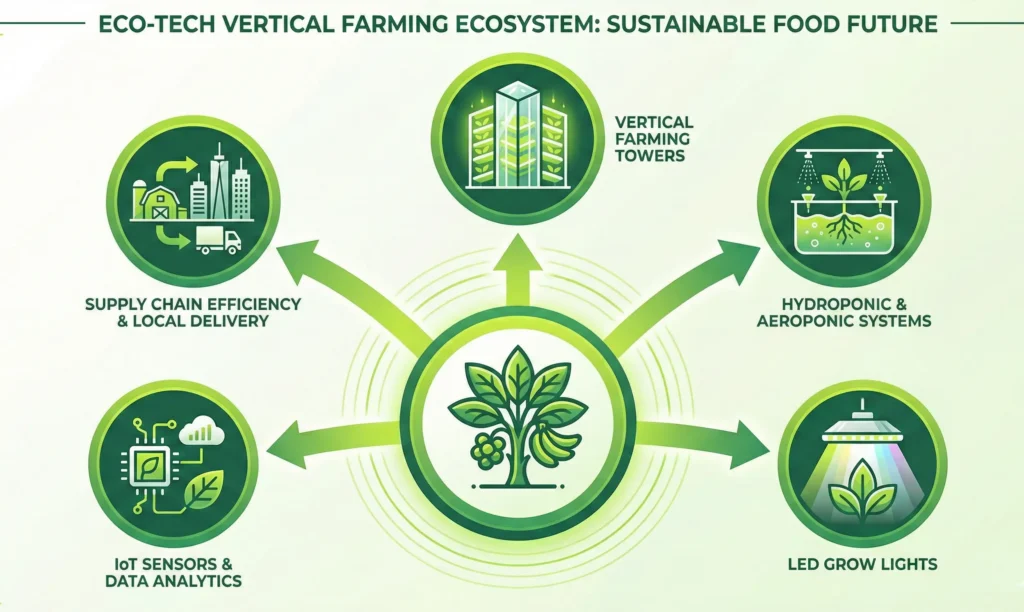
By 2050, the global population is projected to reach nearly 10 billion people, with nearly 70% of humanity residing in urban areas. This demographic shift presents a dual crisis: How do we feed a booming population when arable land is shrinking, and how do we do it without destroying the planet?
For centuries, the answer to “more food” was “more land.” We deforested, irrigated, and fertilized our way to abundance. But today, traditional agriculture is responsible for a significant portion of global greenhouse gas emissions and freshwater withdrawal.
The solution lies at the intersection of environment and agriculture & food tech. Enter vertical farming – a revolutionary approach that flips the farm on its head, quite literally. By integrating advanced food tech with Controlled Environment Agriculture (CEA), we are not just changing where we grow food, we are redefining the relationship between our cities and the natural world.
The Concrete Jungle Becomes a Green Ecosystem
Vertical farming is the practice of growing crops in vertically stacked layers, often integrated into other structures like skyscrapers, shipping containers, or repurposed warehouses. But it is more than just stacking plants; it is a sophisticated, data-driven ecosystem.
Unlike traditional farming, which is at the mercy of weather patterns, pests, and seasons, vertical farms operate in a closed loop. Food Tech systems control every variable – temperature, humidity, light, and nutrient levels – to create the “perfect day” for plants, 365 days a year.
This shift allows for urban agriculture to flourish. Imagine a world where the lettuce in your salad wasn’t trucked 1,500 miles from a field in California but was harvested two hours ago from the building across the street. This is the promise of feeding cities locally.
The Water Revolution: Hydroponics and Aeroponics
One of the most critical environmental benefits of vertical farming is water conservation. Traditional agriculture is thirsty, it accounts for approximately 70% of global freshwater usage. As climate change exacerbates droughts, this model is becoming unsustainable.
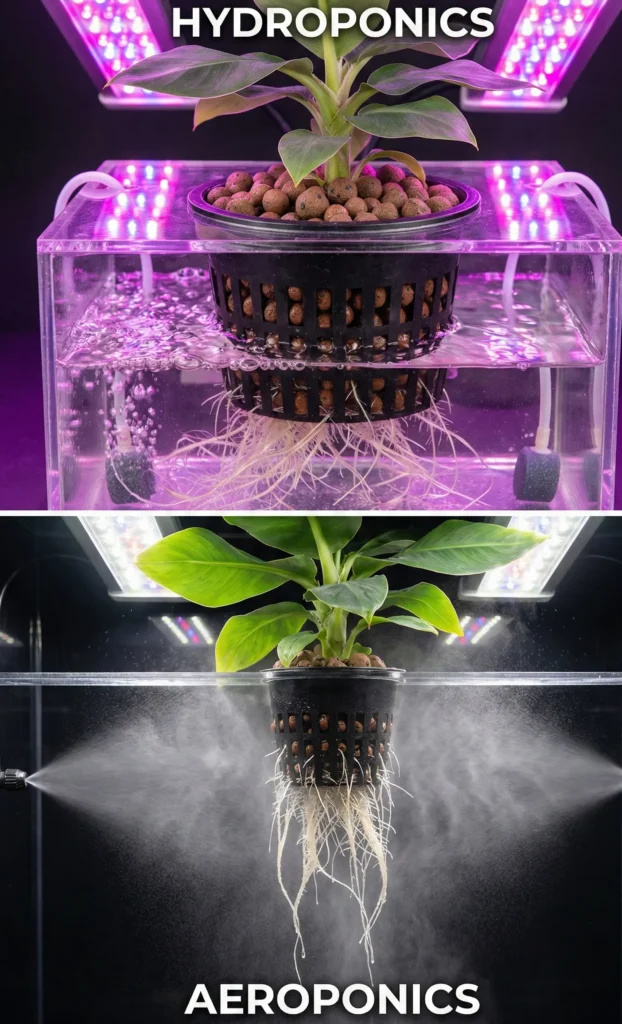
Vertical farming technologies utilizes hydroponics (growing plants in nutrient-rich water) and aeroponics (misting plant roots with nutrients). These systems recirculate water, using up to 95% less water than conventional field farming.
- Closed-Loop Systems: In a vertical farm, water that evaporates or transpires from the plants is captured, dehumidified, and recycled back into the system.
- Zero Runoff: Traditional farms suffer from agricultural runoff, where fertilizers leach into rivers and oceans, causing algae blooms. Vertical farms are sealed environments, ensuring that saving the environment means keeping nutrients in the plants, not in the waterways.
Example of companies using hydroponics and aeroponics systems: AeroFarms, Plenty, Emirates Crop One, Ultragreens.
AeroFarms – A Vertical Farm Grows in Newark
Rewilding the Planet: Land Efficiency
The environmental argument for Vertical Farming extends beyond resources to land use itself. Traditional farming requires vast horizontal acreage. To feed more people, we have historically cut down forests, destroying biodiversity in the process.
Vertical farms are exponentially more efficient. A single acre of vertical farming can produce the equivalent yield of 10 to 20 acres of conventional farmland, depending on the crop. This efficiency offers a radical opportunity for the environment: Rewilding. By concentrating food production in high-tech urban centers, we can potentially return vast tracts of exhausted farmland to nature, allowing forests to regrow and carbon to be sequestered naturally.
The Role of Tech: AI, IoT, and LEDs
The “Tech” in Agriculture & Food Tech is the engine driving this efficiency. A modern vertical farm is as much a software company as it is an agricultural one.
- AI and Machine Learning: Sensors monitor plant health in real-time. Artificial Intelligence analyzes millions of data points to optimize growth recipes. If a basil plant needs 1% more nitrogen or a slightly different light spectrum to improve flavor, the system adjusts automatically.
- LED Efficiency: In the past, the energy cost of artificial lighting was the Achilles’ heel of indoor farming. However, next-generation LEDs have become incredibly energy-efficient. Furthermore, “light recipes” allow farmers to output only the specific light spectrums plants need for photosynthesis (red and blue), wasting no energy on green light that plants reflect.
- Robotics and Automation: From seeding to harvesting, robotics reduce the risk of contamination. This means vertical farms can be effectively pesticide-free. Without the threat of bugs or weeds, there is no need for toxic chemicals, resulting in cleaner food and a safer environment for workers.
Slashing Food Miles and Carbon Footprints
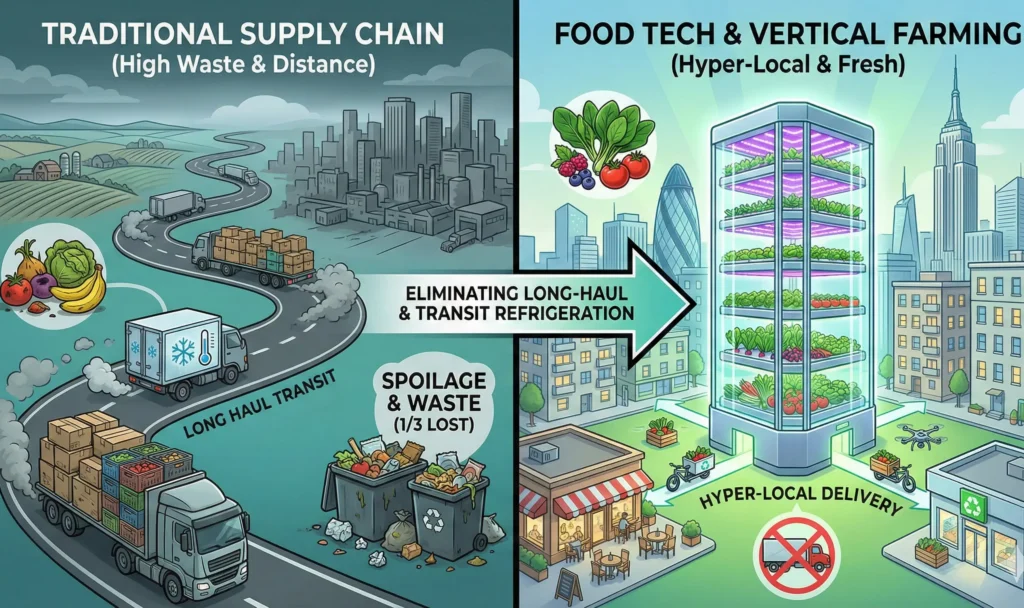
The modern food supply chain is a logistical marvel, but an environmental disaster. The concept of “Food Miles” – the distance food travels from farm to plate – is a major contributor to carbon emissions.
By relocating farms to the heart of urban centers, food tech eliminates the need for long-haul trucking, refrigeration during transit, and extensive packaging.
- Hyper-Local Supply Chains: A vertical farm in London or New York serves the immediate population.
- Reduced Spoilage: Roughly one-third of all food produced globally is lost or wasted, much of it during transport and storage. By shortening the supply chain, vertical farming drastically reduces food waste, which is a massive win for saving the environment.
The Challenges: Energy and Scale
While the narrative is compelling, Vertical farming faces a significant hurdle: Energy consumption. Replacing the sun with LEDs requires electricity. If that electricity comes from coal or gas, the environmental benefits are negated.
However, the trajectory of Agriculture & Food Tech in 2026 is aligning with the renewable energy revolution. Leading vertical farms are increasingly co-locating with renewable energy sources—solar panels on roofs, wind turbines, and biogas facilities that turn organic waste into power. As the grid becomes greener, the carbon footprint of vertical farming drops toward zero.
Furthermore, the crop variety is expanding. While the industry started with leafy greens and herbs, advancements in Food Tech are now enabling the cultivation of strawberries, tomatoes, and even root vegetables in vertical systems, making a complete urban diet a closer reality.
Conclusion: A Symbiotic Future
Vertical farming & food tech represent a fundamental shift in human survival strategy. We are moving from an era of extraction – taking from the earth until it is depleted – to an era of precision and regeneration.
By bringing agriculture indoors and upwards, we protect our food supply from the volatility of a changing climate while simultaneously protecting the environment from the strains of agriculture. It is a symbiotic relationship where technology enables nature to heal.
As we look toward the future, the question is no longer if vertical farming will become mainstream, but how quickly we can integrate it into our cities. The “farmscraper” is not science fiction; it is the necessary evolution of a hungry, urbanized planet.
Hungry for more insights? Dive into our blog to explore the latest trends in Agriculture, Manufacturing, Environment, and Health.
References
- Mohab Taher Abdelfatah – Vertical Farming: A Key To Sustainable Compact Cities → https://www.researchgate.net/publication/382342670_Vertical_Farming_A_Key_To_Sustainable_Compact_Cities;
- Alana Kluczkovski – Urban vertical farming: innovation for food security and social impact? → https://royalsocietypublishing.org/rstb/article/380/1935/20240154/235082/Urban-vertical-farming-innovation-for-food;
- Abdulaziz Aborujilah – Towards Sustainable Vertical Farming: A Systematic Review of Energy Return on Investment Efficiency and Optimization Strategies → https://www.mdpi.com/2071-1050/17/18/8142;
- Swathi Erekath – Food for future: Exploring cutting-edge technology and practices in vertical farm → https://www.sciencedirect.com/science/article/pii/S2210670724001859;
- balancefarms – vertical farming 101: how growing up is feeding the future → https://balancefarms.com/blog/vertical-farming-101/