
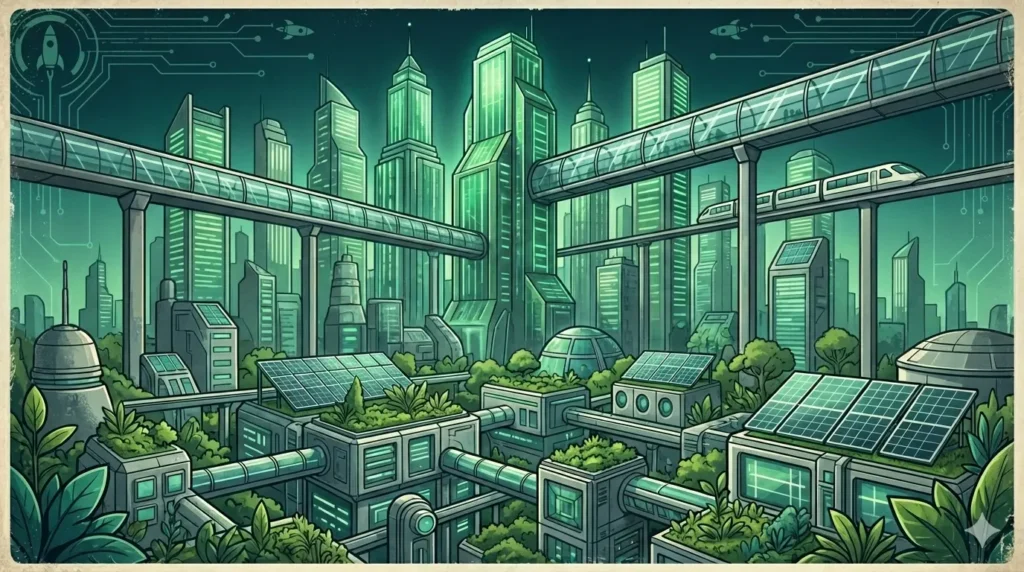
The construction sector in 2026 has undergone a fundamental paradigm shift, moving away from extractive practices toward a regenerative model. This evolution is centered on the widespread adoption of Green Building Materials and the implementation of Sustainable Urban Infrastructure, all of which must now pass a rigorous Ecological Impact Assessment before a single shovel hits the ground. We are no longer just building shelters; we are designing complex ecosystems that must function in harmony with the natural world. This transition is best exemplified by pioneering projects in Northern Europe, which serve as a lighthouse for global developers.
1. The Materiality of the Future
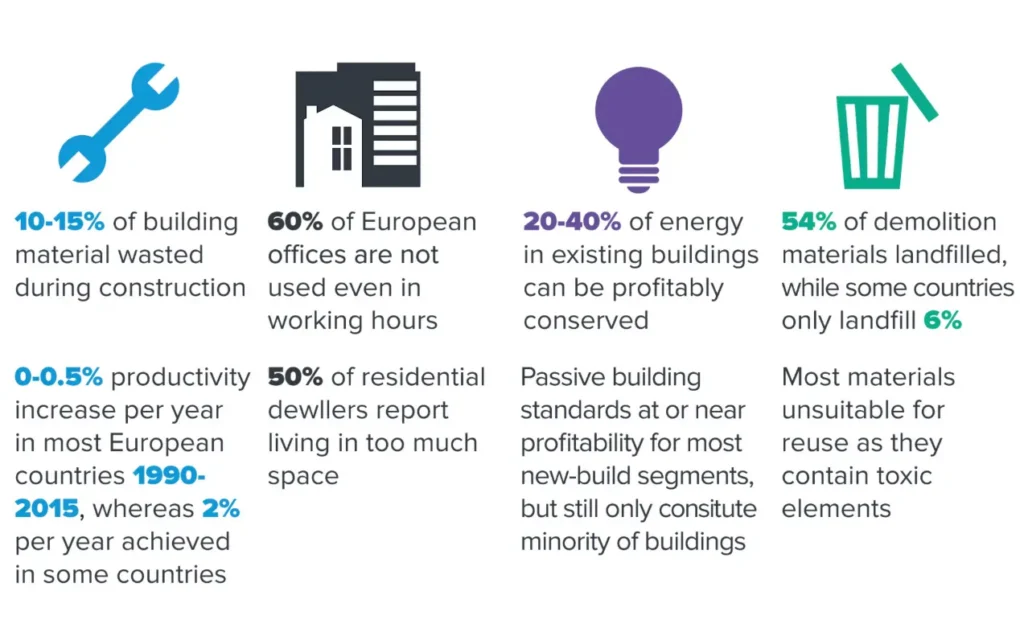
Ellen Macarthur Foundation Cities and the circular economy – deep dive
The first step in this revolution is the rejection of high-carbon tradition. In 2026, Green Building Materials have become the default choice for urban development. Cross-laminated timber (CLT) is now used for high-rise structures that were once the sole domain of steel and concrete. This shift is not merely aesthetic; wood acts as a carbon sink, locking away CO2 for the lifetime of the building.
Furthermore, the industry has embraced geopolymer concretes and recycled aggregates. By utilizing industrial waste streams, manufacturers are producing materials that require 80% less energy to create than traditional Portland cement. This circular approach ensures that every new building contributes to a net-reduction in global emissions, rather than adding to the problem.
2. Case Study: Stockholm Royal Seaport (Norra Djurgårdsstaden)
To understand how these concepts manifest in reality, we must look at the Stockholm Royal Seaport in Sweden. This project is a masterpiece of modern engineering where sustainable urban infrastructure is the backbone of daily life. Built on a former industrial site, Norra Djurgårdsstaden aims to be fossil-fuel-free by 2030. The project utilizes a sophisticated vacuum-based waste collection system, which replaces traditional garbage trucks. This system, designed by Envac, moves waste through underground pipes at high speeds to a central processing plant, drastically reducing local noise and air pollution.
The integration of green building materials is evident in the residential blocks, where wood and low-carbon concrete are used in tandem. But the true innovation lies in the Ecological Impact Assessment protocols used by the city. Every developer must adhere to a “Green Space Index,” ensuring that for every square meter built, a specific amount of functional greenery is returned to the ecosystem. This greenery isn’t just for decoration; it manages stormwater, supports local pollinators, and provides natural cooling during summer heatwaves.
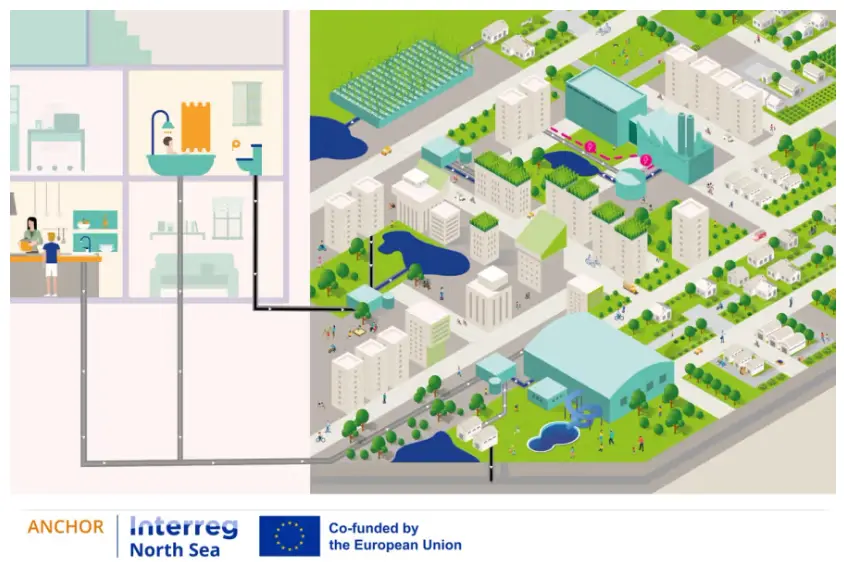
Stockholm Royal Seaport – Circular wastewater management
3. Technological Integration and Governance
Midway through this decade, the success of such projects depends heavily on digital twin technology. By creating a virtual replica of the city, planners can simulate how different Green Building Materials will age and how the Sustainable Urban Infrastructure will handle extreme weather events. This data-driven approach allows for a much more accurate Ecological Impact Assessment, moving beyond static reports to dynamic, real-time environmental monitoring.
Furthermore, B2B collaborations have become more specialized. Construction firms are partnering with biotech companies to develop “living” insulation made from mycelium or algae. These biological systems not only provide superior thermal regulation but also improve indoor air quality by absorbing toxins. This level of innovation requires a complete rethinking of supply chains and procurement processes.
4. The Human Element and Urban Resilience
Sustainable development is not just about carbon, it is about people. Modern urban planning focuses on social equity and health. In 2026, cities are designed to be walkable, with heavy emphasis on public transit and cycling lanes. This reduces the need for expansive asphalt surfaces, which contribute to the urban heat island effect. By replacing parking lots with community gardens and rain gardens, we are creating more resilient cities that can absorb heavy rainfall and provide sanctuary for biodiversity.
5. Logistics and the Autonomous Frontier
The logistics of building in 2026 are increasingly autonomous. Drones are used for site surveys and material delivery in congested urban areas, while robotic exoskeletons assist workers with heavy lifting, reducing workplace injuries. This automation allows for hyper-efficient construction schedules, ensuring that projects like the Stockholm Royal Seaport can scale rapidly without compromising quality or safety.
Conclusion: A New Standard for Humanity
In conclusion, the construction industry has successfully navigated its most difficult challenge: decoupling growth from environmental destruction. By prioritizing the use of Green Building Materials and investing in long-term Sustainable Urban Infrastructure, we have laid the foundation for a resilient civilization. The final and perhaps most important pillar of this success has been the rigorous application of Ecological Impact Assessment, which ensures that our progress does not come at the expense of the natural world. As we look toward the 2030s, the goal is clear: to build not just for today, but for a future where every structure contributes more to the planet than it takes.
Read more articles about construction, IT & AI , environment, marketing, education and more.
References
- Ellen Macarthur Foundation → Cities and the circular economy – deep dive;
- Ellen Macarthur Foundation → Building a world free from waste and pollution;
- Stockholm Royal Seaport → ANCHOR – Capacity building for circular wastewater management;
- World Green Building Council → WorldGBC Net Zero Carbon Buildings Commitment expands to include embodied carbon;
- UN Environment Programme → Global Status Report for Buildings and Construction 2024/2025;
- European Council → The construction sector towards 2030, Final publishable report;
- European Council → Sustainable urban development;
- A research project commissioned by Siemens Limited → Sustainable Urban Infrastructure Dublin Edition – a view to 2025;