
The global market has entered a new stage of maturity in 2026, where the success of any real estate investments critically depends on access to flexible financial services and the adoption of sustainable constructions solutions that meet strict new ecological standards. We no longer discuss urban development without considering the carbon footprint and energy efficiency of buildings. Investors have realized that the long-term value of assets is dictated by their resilience to climate change and their ability to attract green financing, transforming the entire construction sector into a laboratory for technological and financial innovation.
Construction Sector Evolution: Advanced Materials and Technologies
The year 2026 marks the end of the traditional concrete era as the sole mass solution. The sustainable constructions sector has widely adopted negative-emission cement and cross-laminated timber (CLT) for multi-family residential buildings and corporate offices. These materials do not just reduce pollution; they also significantly shorten execution times, which is a key factor for the overall profitability of any real estate investments. The digitalization of construction sites through the widespread use of Digital Twins allows for real-time monitoring of resource consumption, eliminating waste and design errors that, in the past, used to inflate budgets by up to 20%.
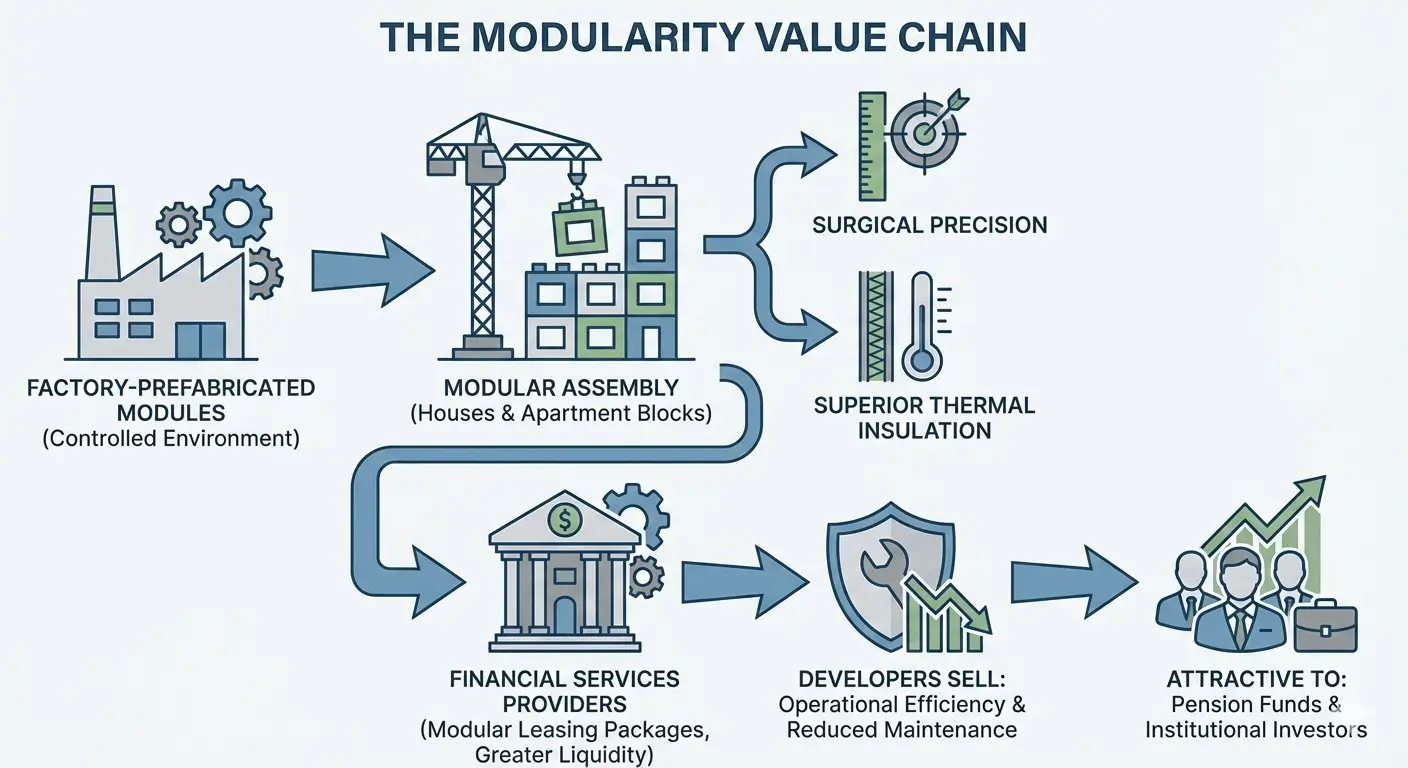
Modularity has also become an industry standard. Houses and apartment blocks assembled from factory-prefabricated modules in controlled environments offer surgical precision and superior thermal insulation compared to old methods. This business model has caught the attention of major financial services providers, who now offer real estate leasing packages specifically designed for modular structures, allowing for greater liquidity in the residential market. Developers no longer sell just square footage; they sell operational efficiency and reduced maintenance costs, making their assets much more attractive to pension funds and institutional investors.
Financial Services and the Democratization of Capital
The banking sector and FinTech companies have revolutionized the way large infrastructure projects are funded. In 2026, the provision of financial services is no longer limited to standard mortgages. We have witnessed an explosion in the tokenization of real estate assets. Through blockchain technology, an office building can be split into thousands of digital fractions, allowing small-scale investors to participate in major real estate investments that were previously reserved exclusively for millionaires or large corporations. This democratization has led to a massive injection of capital into sustainable constructions projects, accelerating urban regeneration in secondary cities.
Furthermore, ESG (Environmental, Social, and Governance) criteria have become mandatory for any major line of credit. Banks no longer grant financing for projects that do not demonstrate a clear strategy for waste reduction or the use of renewable energy. This rigorous filtering has led to a market cleanup, eliminating speculative developers in favor of companies that prioritize social responsibility. Thus, the stability of the financial system is now intrinsically linked to the health of the construction sector, creating a virtuous circle of sustainable economic growth.
Urban Resilience and Smart Cities: The 2026 Model
The smart cities of 2026 are the result of close collaboration between architects, urban planners, and financial analysts. Infrastructure is no longer viewed as a fixed cost, but as an asset that generates data and value. The integration of photovoltaic panels directly into building facades and sophisticated rainwater harvesting systems are now standard features in any sustainable constructions project. These buildings function as actual micro-power plants, capable of selling surplus energy back to the grid, creating a secondary revenue stream for owners. This energy efficiency significantly reduces the risk of loan defaults, a crucial aspect for institutions providing financial services.
Moreover, the “15-minute city” concept has reshaped strategies for real estate investments. Demand for mixed-use spaces—combining residential, workspaces, and leisure facilities—has far exceeded the demand for traditional offices in financial districts. Citizens are looking for proximity and quality of life, and capital naturally follows this trend. Regeneration projects turning old industrial zones into green urban centers are now the most profitable assets in global portfolios, often benefiting from government subsidies and preferential interest rates.
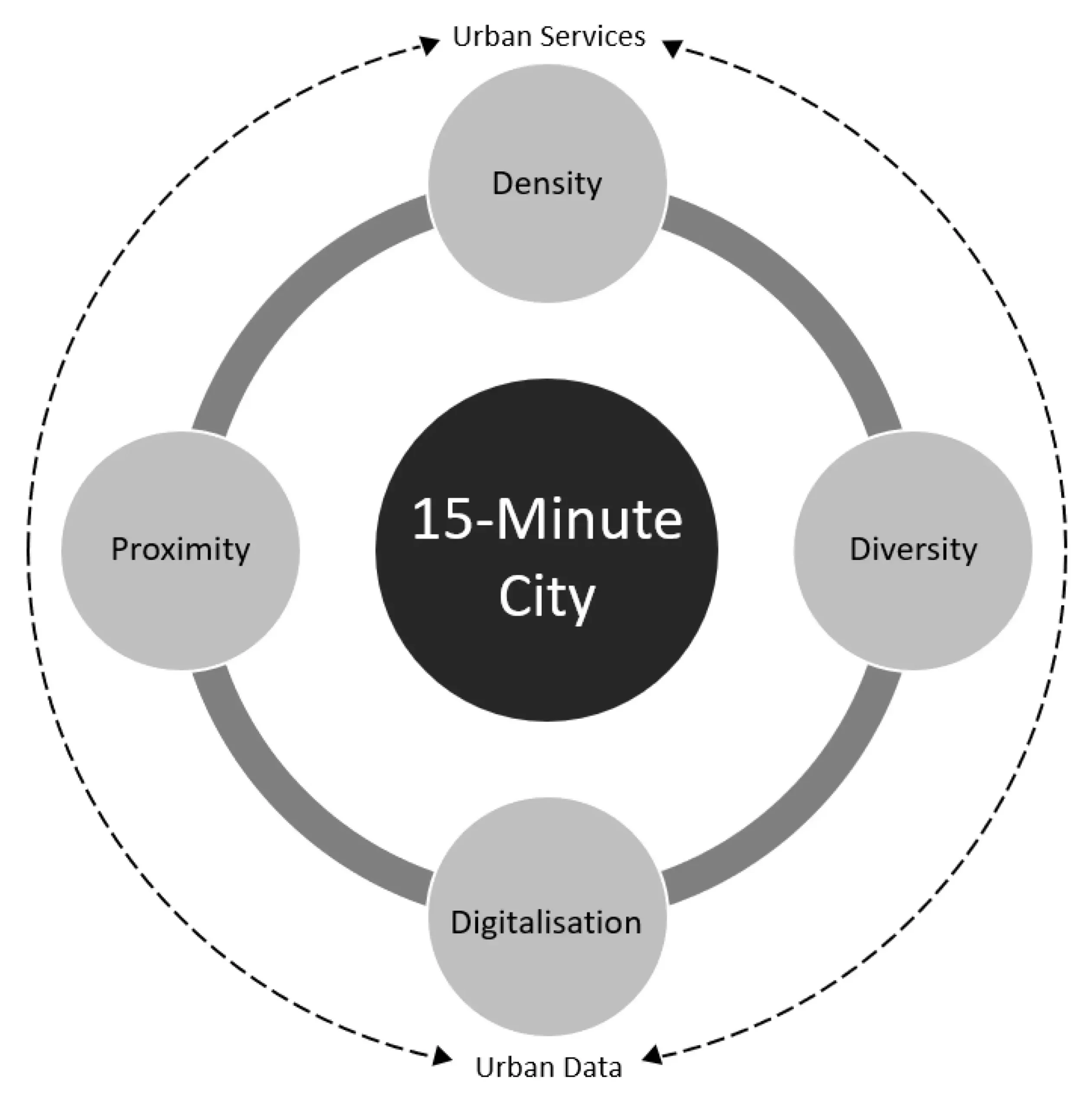
Moreno, C.; Allam, Z.; Chabaud, D.; Gall, C.; Pratlong, F. Introducing the “15-Minute City”: Sustainability, Resilience and Place Identity in Future Post-Pandemic Cities. Smart Cities 2021, 4, 93-111
Risks and Crisis Management in a Changing World
Of course, 2026 is not without its challenges. Inflation in the price of critical raw materials and the shortage of skilled labor in the green technology field put constant pressure on profit margins. This is where advanced insurance solutions and hedging instruments offered by major financial services firms come into play. Risk management has become much more predictive, utilizing global databases to anticipate market fluctuations and protect sustainable constructions projects from supply chain bottlenecks.
Investors are now much more attentive to asset liquidity. In a world where interest rates can fluctuate rapidly, the flexibility of financing structures is vital. Those who manage to combine the success of traditional real estate investments with the agility of new digital platforms are the ones who will dominate the decade. We are seeing a clear shift from pure ownership toward the “Real Estate as a Service” (REaaS) model, where the user pays for the experience and utility, rather than just the raw physical space.
Conclusion: An Integrated and Responsible Future
In conclusion, economic success in 2026 is defined by the ability to harmoniously integrate capital flows with high-precision technical execution. Whether planning massive real estate investments or perfecting new financial services, the ultimate goal remains the same: creating a built environment that is both durable and inclusive. Adopting high standards in sustainable constructions is no longer an aesthetic or ethical choice, but a fundamental economic necessity for business survival.
The future belongs to those who understand that a building is a complex ecosystem, and capital is the energy that keeps it alive. Through collaboration, innovation, and a clear vision for resource protection, the financial and construction sectors can ensure long-term prosperity for future generations. In 2026, we have learned that profit and sustainability are not opposing forces, but two sides of the same coin that will define human progress for the rest of this century.
Read more articles about construction, IT & AI , environment, marketing, education and more.
References
- Swiss Sustainable Finance → Sustainable Real Estate Investments;
- Reportage Turkiey → Sustainable Real Estate Investment Building The Future;
- Invesdor → Sustainable real estate investments: real estate as a key to a livable future;
- JLL → The hidden power of real estate in financial services M&A;
- Meru Accounting → Financial Planning for Real Estate Investments: Tips and Techniques;
- Science Direct → Real Estate Investment;
- The Knowledge Academy → What is Real Estate Investment? Everything You Should Know;
- Glion → How to learn the ropes in real estate financing;
- MDPI → Introducing the “15-Minute City”: Sustainability, Resilience and Place Identity in Future Post-Pandemic Cities